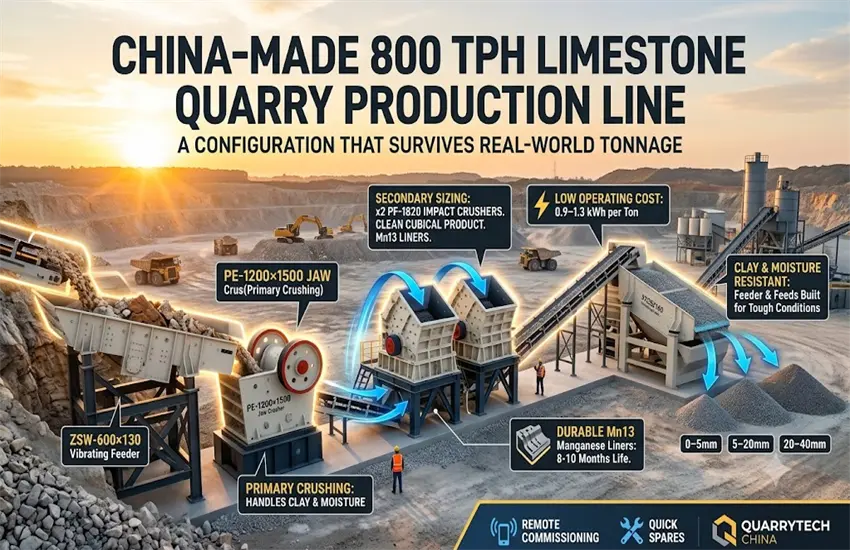
If you’re scoping out an 800 TPH limestone line, you’ve probably already heard a dozen suppliers promise the world. Big numbers, glossy renders, “fully automated” everything. But here’s the thing — limestone at this scale doesn’t care about renders. It cares about whether your primary crusher chokes on a rainy Tuesday when the feed comes in sticky with clay, and whether your liners are still in spec six months later. Let’s talk about what an 800 TPH line actually needs to hold up.
Compared to granite or basalt, limestone is genuinely easier on equipment. Most quarry-grade limestone sits at an unconfined compressive strength (UCS) of roughly 60–150 MPa, with a Bond Work Index somewhere around 11–13 kWh/t — noticeably softer than the 15–20 kWh/t you’d see crushing harder igneous rock. The abrasion index is low too, often under 0.3, so wear costs per ton are lower than most operators expect.
That’s the good news. The bad news is moisture and clay content. Limestone deposits, especially near riverbeds or in karst-heavy regions, often carry fines and clay that turn sticky after rain. At 800 TPH, even a small blockage at the jaw crusher’s feed opening cascades fast — downstream screens starve, conveyors run uneven, and your “800 TPH line” quietly becomes a 550 TPH line by 2pm. Sound familiar?? You’re not alone, this is the single most common complaint we hear from limestone quarry managers.
For limestone at this tonnage, we generally specify a two-stage crushing setup: a heavy-duty jaw crusher as primary, feeding into impact crushers for secondary sizing, with vibrating screens producing the final gradations. Impact crushers (PF series) suit limestone particularly well because the low abrasion index means blow bars don’t sacrifice themselves every few weeks — and limestone’s tendency to break along cleavage planes gives you cleaner cubical product than you’d get on harder stone.
| Stage | Equipment / Model | Key Parameter | Capacity |
|---|---|---|---|
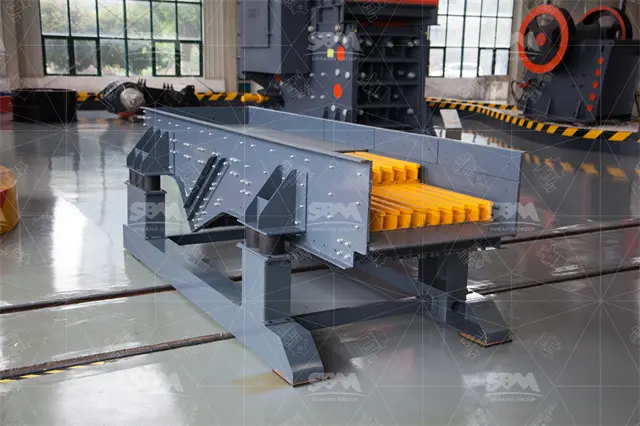
| Feeding | ZSW-600×130 Vibrating Feeder | Feed opening 600×1300mm | up to 850 t/h |
| Primary Crushing | PE-1200×1500 Jaw Crusher | Max feed 1020mm, OSS adjustable 150–300mm | 400–800 t/h |
| Secondary Crushing | PF-1820 Impact Crusher (×2) | Rotor dia. 1800mm, CSS tuned per gradation | 380–650 t/h each |
| Screening | 3YZS2160 Vibrating Screen | 3-deck, producing 0–5 / 5–20 / 20–40mm | matches line throughput |
Notice we’re spec’ing Mn13 manganese liners across most of this line rather than the Mn18Cr2 high-chrome liners we’d push for granite or river-stone projects. With limestone’s abrasion index this low, Mn13 holds up fine and costs less per set — and replacement cycles stretch out, which matters a lot once you’re running three shifts.
On a typical 800 TPH limestone line built around this setup, operators report power draw landing around 0.9–1.3 kWh per ton of finished product, depending on how fine the secondary screen decks are set and how wet the feed runs. Jaw crusher liner sets on limestone duty often last 8–10 months before swap-out versus 4–6 months on granite lines, that gap alone covers a meaningful chunk of your operating margin over a year.
One operator running a similar configuration on a riverside limestone deposit told us their biggest win wasn’t even the crusher itself — it was switching the primary feeder’s grizzly bar spacing to handle the wet clay better, which cut unplanned stoppages by close to a third.
Every limestone deposit is different — moisture, clay content, target gradation, and your downstream market (cement feed, road base, agricultural lime) all change the right setup. If you send us your gradation curve, feed moisture, and target product split, our engineers can sketch a configuration sized for your actual 800 TPH target, not a generic one. No pressure, just numbers on paper before you commit to anything.
Q1: Can the line run on 60Hz, 460V power? We’re not on 50Hz/380V.
Yes. Motors, drives, and control panels are configured to your local grid voltage and frequency before shipment — this is standard, not a custom request.
Q2: How long do the jaw crusher liners last on limestone?
Typically 8–10 months under normal duty with Mn13 liners, longer if your feed runs drier and less abrasive than average.
Q3: What’s the lead time for spare parts after installation?
Critical wear parts (liners, blow bars, screen mesh) ship within 7–15 days for most destinations. We recommend stocking one spare set on-site from day one.
Q4: Do you provide installation supervision, or do we self-install?
Both options exist. Most clients take remote video-guided commissioning with an engineer on standby; on-site supervision is available as an added arrangement.
Q5: What about customs clearance and import documentation?
We provide full export documentation (commercial invoice, packing list, certificate of origin, and bill of lading) compatible with standard customs procedures, your local freight forwarder handles clearance on their end.
Q6: Will the impact crusher handle limestone with high clay content without clogging?
Generally yes, but if your moisture content runs above roughly 8%, we’d recommend a scalping screen ahead of the primary crusher to pull fines out before they cause buildup.
Q7: How is the foundation/civil work scoped — do you provide drawings?
Yes, foundation layout drawings and load specifications come with the equipment package so your local civil contractor can prepare the site in parallel with shipping.
Q8: What’s your after-sales response time for technical issues?
Standard response within 24 hours for technical queries, with remote diagnostics available via video call for most mechanical and electrical issues.
Whatsapp:+8617329420102
Email: [email protected]
Address: No. 1688, Gaoke East Road, Pudong new district, Shanghai, China.
Online Service : Get Price
We value your feedback! Please complete the form below so that we can tailor our services to your specific needs.