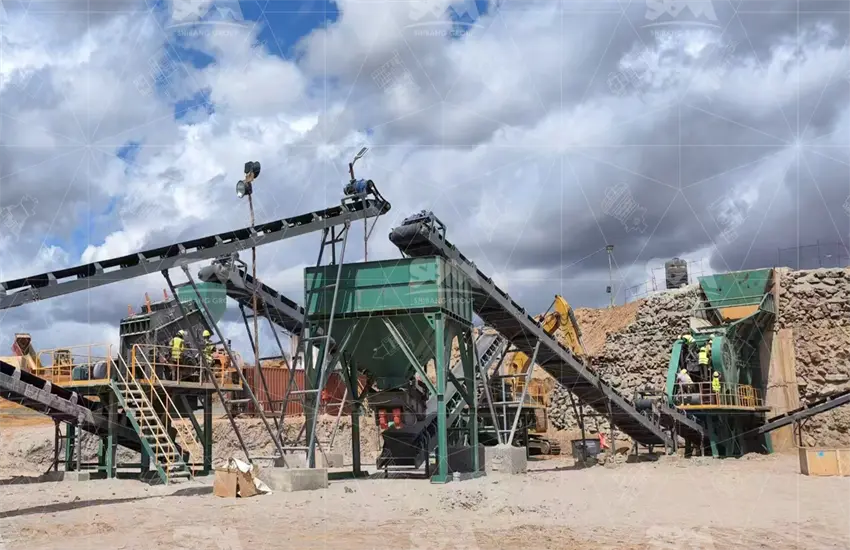
Ore hardness is one of the biggest factors when picking a crusher. Get it wrong, and you end up with high wear costs, low output, or equipment failures. This guide walks you through how hardness affects your choice, with real data and practical tips to help you decide.
Ore hardness tells you how much resistance a rock puts up when you try to break it. Engineers use the Mohs scale (1–10) and the Bond Work Index (BWI) to measure this. Mohs gives a quick comparison. BWI gives you the energy needed to grind one ton of ore to 80% passing 100 microns — a number you actually use in design.
Soft ores like limestone sit around BWI 8–12 kWh/t. Hard ores like granite or taconite push past 20 kWh/t. That gap changes everything — from the crusher type you pick to the motor size you need. Ignoring hardness means you either oversize (waste money) or undersize (damage equipment fast).
Before you select any crusher, collect these numbers from your ore sample tests:
These parameters come from ASTM E382 and ISO 11536 test methods. Get lab results before finalizing equipment specs. Skipping this step leads to costly changes later.
Different crushers break rock in different ways. Jaw crushers squeeze rock between two plates — good for hard, blocky feed. Cone crushers crush by compression between a mantle and concave — great for medium to hard ores requiring shape control. Impact crushers use high-speed hammers or blow bars — efficient for soft to medium ores but wear fast on hard abrasive rock.
The hardness decides which mechanism works best. Soft limestone (UCS 30–80 MPa) breaks easily under impact. Hard granite (UCS 160–250 MPa) needs sustained compression. Forcing a soft-ore machine onto hard ore wears it out in weeks. The right match reduces operating cost per ton significantly.
| Ore Hardness | UCS (MPa) | BWI (kWh/t) | Recommended Crusher | Typical Application |
|---|---|---|---|---|
| Soft | Below 80 | 5–12 | Impact crusher (HSI/VSI) | Limestone, coal, gypsum |
| Medium | 80–150 | 12–18 | Jaw + cone (secondary) | Basalt, sandstone, dolomite |
| Hard | 150–250 | 18–28 | Jaw (primary) + cone (fine) | Granite, quartzite, iron ore |
| Very Hard / Abrasive | Above 250 | Above 28 | Gyratory + multi-cylinder cone | Taconite, chromite, corundum |
This table gives a starting point. Always cross-check with your abrasion index value. A medium-hardness ore with Ai above 0.4 still needs wear-resistant liner materials — same as a hard ore setup.
Jaw crushers handle primary crushing of hard rock well. Key specs to check:
Jaw plates are often made from Mn13 or Mn18 manganese steel. For ores with above 0.3, use Mn18Cr2 for longer service life. Plate life can range from 300 to 1,500 hours depending on ore abrasivity.
Cone crushers work after the jaw crusher to reduce ore further. Key parameters:
For hard ores (BWI above 18), use a multi-cylinder hydraulic cone. It handles tramp iron better and adjusts CSS automatically. Single-cylinder cones suit medium-hardness ore with lower abrasion.
Horizontal shaft impactors (HSI) and vertical shaft impactors (VSI) suit soft ores. Main specs:
VSI crushers also improve particle shape — useful for sand and aggregate production. But feeding hard ore (UCS above 150 MPa) into an impact crusher damages blow bars within hours. Match the machine to the rock.
Many operations buy equipment based on throughput targets alone. They skip the hardness and abrasion tests. Then wear parts fail early, downtime spikes, and per-ton costs jump. A jaw crusher running on ore 30% harder than designed wears jaw plates 2–3 times faster. That adds up fast across a full year of operation.
Getting a proper ore characterization test costs $500–$2,000 per sample. Choosing the wrong crusher costs tens of thousands in extra wear parts and lost production time. The test pays for itself on day one of correct operation. If you do not have BWI and data yet, we can help you interpret lab reports and size equipment accordingly.
Not always. Bigger is not always better. A gyratory crusher has high capacity but also high capital cost and a large footprint. Many hard ore projects do fine with a jaw crusher at primary stage and a hydraulic cone at secondary — if the feed is properly sized and the circuit is designed for the material.
The key is matching specific energy consumption (kWh/t) to your throughput target. For example, a 500 t/h granite plant (BWI = 22 kWh/t) might need 180–220 kW installed at secondary crushing alone. You size the cone based on that, not just on the feed opening. Bigger equipment means bigger power draw and higher operating cost per hour — even if the capital cost is spread over more tons.
Mixed ore happens often in open-pit mining. The feed may contain both soft clay zones and hard quartzite veins. This variable hardness causes uneven wear and unpredictable throughput. A few approaches work well:
The worst mistake is running a fixed-setting crusher at full rate through variable ore without any feed control. It cracks mantles, bends shafts, and trips overload systems repeatedly. If your ore is variable, we size for the hard fraction and build in feed-rate flexibility.
Moisture above 5–8% causes problems even in compression crushers. Wet fines pack into the crushing chamber and restrict flow. The crusher chokes, power draw spikes, and output drops. In some cone crushers, wet clay coats the liners and acts like a cushion — reducing the effective force applied to the rock.
Solutions depend on your climate. In tropical operations, a pre-drying stage or covered stockpiles can reduce surface moisture. Screen out wet fines before the primary crusher. Some jaw crusher designs include a steeply-angled toggle plate that improves self-cleaning in wet conditions. Tell us your average moisture levels when requesting a quote — we factor that into the liner design and cavity selection.
A granite quarry in tropical Southeast Asia needed 400 t/h of 0–30 mm crushed aggregate. The granite showed UCS of 195 MPa, BWI of 21.5 kWh/t, and Ai of 0.38. Annual rainfall exceeded 2,400 mm, so wet ore was a constant issue.
The selected circuit used a PE750 × 1060 jaw crusher at primary stage and an HPT300 multi-cylinder hydraulic cone at secondary. CSS was set to 120 mm (jaw) and 16 mm (cone) to meet the 0–30 mm target in two stages. A vibrating screen between stages removed passing material and reduced cone load.
The site manager noted that the hydraulic overload protection saved the cone twice in the first three months when tramp iron entered the feed. The automatic CSS reset after each event took under two minutes. The maintenance crew said locking the mantle during liner change was faster than their previous equipment — roughly 4 hours per change versus 7 hours before.
An iron ore operation in West Africa required a primary crushing solution for hematite with UCS 240 MPa and BWI 26.3 kWh/t. Feed came from blasted rock with F80 of 650 mm. Target product was sub-150 mm for downstream SAG milling at 600 t/h.
A CG850i gyratory crusher was selected for primary duty given the feed size and hardness. Concave segments used high-manganese steel with a chromium addition to resist the high abrasion. The crusher ran in open circuit with a grizzly feeder upstream to reject fines and reduce recirculating load.
The production supervisor highlighted that remote CSS monitoring let them track liner wear trends without manual measurements. They adjusted CSS in 2 mm steps as the mantle wore, keeping product size on target throughout the liner life. The maintenance team said remote diagnostics flagged a bearing temperature anomaly early — they caught it before it became a failure.
Crusher selection based on hardness data reduces total cost of ownership in several ways. Correct liner material selection based on Ai reduces wear part spend by 20–40% compared to using standard alloys on the wrong ore. Proper motor sizing avoids running at overload — which shortens motor life and raises energy cost per ton.
A two-stage circuit (jaw + cone) typically costs less to operate than a three-stage circuit for hard ore because each reduction step is designed for the specific feed. Adding a screening stage between jaw and cone reduces recirculating load — it often pays back within 6–12 months through reduced cone wear. We model your ore data and throughput targets before recommending any configuration, so you see the cost case clearly before committing.
We provide commissioning support on-site for all projects above a certain scale. Our engineers check CSS settings, lubrication system function, belt feeder calibration, and control system integration before handover. Remote monitoring connection is set up during commissioning so our team can track key parameters from day one.
Spare parts availability matters for hard ore operations. Liner change is a regular event — often every 500–1,200 hours. We stock fast-moving parts in regional warehouses to reduce lead time. For remote sites, we help plan a recommended spare parts inventory at commissioning. Service contracts are available for scheduled maintenance visits, lube oil analysis, and wear part management. You focus on production — we support the equipment behind it.
Check the UCS and Ai values from your ore test. If UCS exceeds 150 MPa or Ai exceeds 0.3, an impact crusher will wear blow bars very fast — often under 50 operating hours in extreme cases. Repair and replacement cost will far exceed any savings from the lower equipment price. Compression crushers (jaw, cone, gyratory) are built for this range. If you only have a Mohs hardness reading, anything above Mohs 6 (quartz-level) puts you in the caution zone for impact crushing. Send us your test report and we can advise on the right fit.
It depends on how variable the feed is and how different the hardness levels are. If your soft fraction is below 80 MPa UCS and your hard fraction goes above 180 MPa, using one crusher for both creates a design compromise — you either overstress the machine on hard ore or run inefficiently on soft ore. A better approach is to separate the ore streams by source if possible, or use a hydraulic cone with automatic CSS adjustment that can handle hardness variation without manual intervention. We have handled projects with variable ore by designing the liner profile for the hard fraction and adjusting feed rate for the soft fraction using a variable-speed belt feeder.
For hard ore (UCS above 150 MPa), keep reduction ratio between 4:1 and 6:1 per stage. Going beyond 7:1 in a single jaw or cone stage increases liner wear significantly and raises the risk of packing (the crushed material blocking the chamber). A jaw crusher set too tight wastes energy and accelerates toggle wear. A cone crusher set too fine relative to its cavity type causes particle interlock in the chamber — output drops and power spikes. Two well-designed stages at 5:1 each give you 25:1 overall reduction with better efficiency and longer liner life than one stage trying to do the same work.
Ore hardness shapes every part of crusher selection — from machine type and motor size to liner material and maintenance intervals. Starting with proper test data (BWI, UCS, Ai, feed size) lets you size equipment accurately and avoid costly surprises in the field.
We work with mine operators, quarry managers, and EPC contractors to size crushing circuits based on real ore data — not generic assumptions. As a manufacturer, we design and build the equipment, supply spare parts, and support commissioning. That means one point of contact from selection to production. If you have ore test data ready, share it with us and we can size a circuit and give you a performance guarantee. If you do not have test data yet, we can guide you on what tests to run and which labs to use. Reach out through our inquiry form — tell us your ore type, target output, and location, and we will get back to you with a sizing recommendation.
Whatsapp:+8617329420102
Email: [email protected]
Address: No. 1688, Gaoke East Road, Pudong new district, Shanghai, China.
Online Service : Get Price
We value your feedback! Please complete the form below so that we can tailor our services to your specific needs.