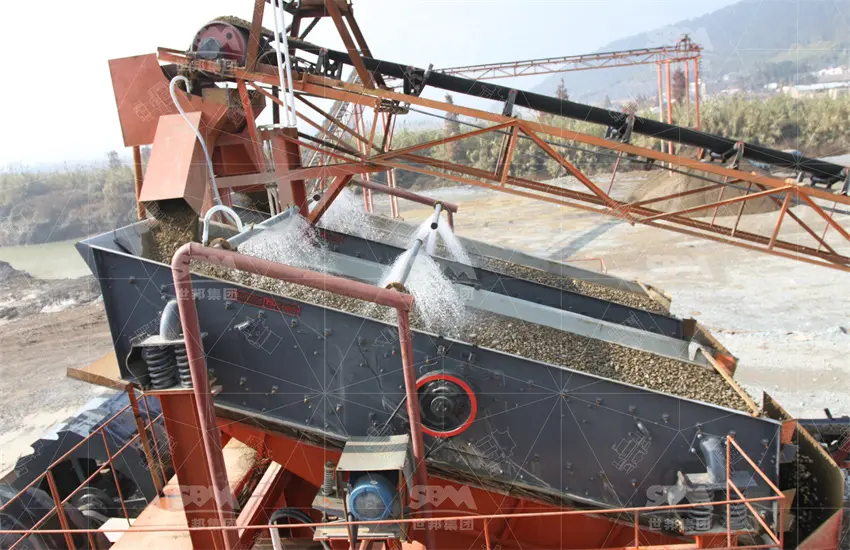
High-clay ores create serious problems in mineral processing plants. Clay particles clog screens, blind wash decks, and reduce recovery rates fast. This article covers equipment selection, process flows, and practical solutions, ensuring that the beneficiation plant maintains smooth operations even when the ore’s clay content exceeds 15%.
Clay minerals — mainly kaolinite, montmorillonite, and illite — have platey structures that hold water. When wet, they swell and stick. That stickiness causes material to clump, coat equipment surfaces, and block apertures in screens or crushers.
Clay content above 10% by weight is generally considered problematic. Above 20%, standard dry crushing circuits often fail completely.
Key indicators of high-clay ore behavior:
Choosing the right equipment is the first decision. Each machine handles clay differently, and the wrong choice costs you throughput and maintenance hours.
A rotary scrubber uses tumbling action inside a rotating drum to break clay bonds. Feed material and water enter together. The drum rotates at 50–70% of critical speed, typically 8–15 RPM for a 2.5 m diameter drum. Retention time runs 3–8 minutes depending on clay hardness.
Scrubber throughput ranges from 50 t/h for a 1.2 m unit up to 1,500 t/h for large 4 m drums. Water addition runs 0.5–2.0 m³ per tonne of feed. Steel lifters inside the drum lift and drop material, creating the scrubbing energy needed to separate clay from valuable minerals.
Log washers handle tougher, more cohesive clays that scrubbers cannot fully break. Two counter-rotating paddle shafts create an aggressive scrubbing action. The paddles, called “logs,” fling material against each other at 30–60 RPM shaft speed.
Log washers suit ores with PI above 25. They consume more power — typically 15–45 kW per metre of shaft length — but they remove clay that scrubbers leave behind. Feed size limit is usually 150 mm top size.
Trommels classify and wash at the same time. A rotating cylindrical screen lets fine clay pass through while retaining coarse clean product. Aperture sizes range from 6 mm to 150 mm. Spray bars inside the drum direct high-pressure water at 2–4 bar onto the material.
Trommel efficiency drops when clay content exceeds 30%. In those cases, pair the trommel with a scrubber upstream to pre-wash the feed before classification.
Running a clay circuit without knowing your process numbers leads to guesswork. The table below shows the main parameters and their typical operating ranges.
| Equipment | Parameter | Typical Range | Why It Matters |
|---|---|---|---|
| Rotary Scrubber | Drum Speed | 8–15 RPM | Controls scrubbing intensity and retention time |
| Rotary Scrubber | Water Addition | 0.5–2.0 m³/t | Dilutes clay slurry for effective washing |
| Rotary Scrubber | Fill Level | 10–20% volume | Too full reduces tumbling; too empty wastes energy |
| Log Washer | Shaft Speed | 30–60 RPM | Higher speed increases clay removal but raises wear |
| Log Washer | Feed Top Size | ≤150 mm | Oversized feed jams paddles |
| Log Washer | Motor Power | 15–45 kW/m shaft | Higher PI ores need more installed power |
| Trommel Screen | Aperture Size | 6–150 mm | Sets the cut point between clay fines and product |
| Trommel Screen | Spray Pressure | 2–4 bar | Insufficient pressure leaves clay on product surface |
| Trommel Screen | Inclination Angle | 3–7° | Controls material transport speed through drum |
Not every clay problem needs the same solution. The table below links clay severity to equipment choice, so you can match the machine to your actual ore condition.
| Clay Content (%) | Plasticity Index | Recommended Equipment | Circuit Configuration |
|---|---|---|---|
| 5–10% | <10 | Vibrating screen with spray bars | Single-stage washing |
| 10–20% | 10–20 | Rotary scrubber + trommel | Scrub then classify |
| 20–35% | 20–30 | Log washer + trommel | Aggressive wash then wet screen |
| >35% | >30 | Two-stage scrubbing + log washer + classifying screen | Full wet circuit with clay thickener |
| Any level, arid climate | Any | Dry screening + dust suppression first | Wet circuit only where water is available |
Screen blinding — where clay particles plug apertures and stop material from passing — is the most common complaint in clay-heavy plants. Operators clean the screen, run it for an hour, and the blinding comes back.
The root cause is usually one of three things. First, the feed is too wet and clay has turned into a paste before it hits the screen. Second, the spray pressure is too low to flush clay out of the apertures. Third, the aperture size is too close to the clay particle size — clay wedges in and stays.
Practical fixes:
If blinding persists after all these steps, the clay type may be smectite-group (swelling clay). Those clays need chemical dispersion — typically sodium hexametaphosphate at 200–400 g/t — before any screening takes place.
Clay causes packing inside crusher chambers. The material does not break cleanly — it compresses, sticks to liners, and blocks the discharge. Power draw climbs, throughput drops, and liner wear accelerates unevenly.
Jaw crushers tolerate clay content up to about 15% if the feed is dry. Beyond that, material packs in the crushing chamber and the machine chokes. Cone crushers are even more sensitive — clay content above 10% in a wet feed typically causes packing within minutes.
Solutions that work in practice:
Monitor power draw continuously. A 10–15% rise in steady-state power usually signals clay buildup before the operator can see it visually. Automated load monitoring tied to an alarm gives you 3–5 minutes of warning before a full choke.
Wet clay circuits produce large volumes of fine slurry. That slurry carries your wash water, suspended clay particles, and sometimes fine mineral values. Managing it properly protects water supply and prevents tailings dam problems.
A typical high-clay washing circuit generates 1.5–3.0 m³ of slurry per tonne of feed at 5–15% solids by weight. Without treatment, that volume is too large to discard and too dilute to pump economically.
Standard slurry management steps:
In arid regions where water is expensive or scarce, even higher recirculation rates of 90%+ are possible with a well-designed thickener-filter circuit. The capital cost pays back quickly through reduced water purchase costs.
Many deposits show variable clay content. The near-surface ore after wet season rains can have 35% clay, while dry-season production from the same pit runs at 12%. A fixed circuit designed for one condition performs badly at the other.
Building flexibility into your circuit is the answer. Variable-speed drives on scrubber and trommel drives let operators adjust retention time and drum speed without stopping the plant. That single investment often recovers its cost in the first wet season by preventing unplanned shutdowns.
Other flexibility features worth considering:
A direct-shipping iron ore operation in a high-rainfall tropical zone faced severe clay problems. Feed ore carried 28–40% clay (PI = 32) during the eight-month wet season. The original dry screening circuit lost 18% of production time to blinding and choke events every wet season.
The plant installed a two-stage wet circuit: a 3.2 m diameter rotary scrubber (retention time 6 minutes, drum speed 11 RPM, water addition 1.6 m³/t) followed by a 3.0 m diameter trommel screen with 20 mm apertures and polyurethane panels. A thickener with polyacrylamide flocculant treated the overflow slurry at 80 g/t dosage.
Measured performance after commissioning:
The plant maintenance supervisor noted that the trommel panels needed replacement after 8,000 hours, which matched the supplier’s stated wear life. The scrubber drive required one bearing replacement at 11,000 hours, which the team did during a scheduled 48-hour maintenance window without production impact.
An alluvial gold operation in a river valley deposit processed feed with 22–30% clay content and significant fine gold (80% passing 0.5 mm). Clay was causing fine gold losses — clay-coated gold particles were reporting to the tailings with the clay fraction instead of to the gold recovery circuit.
The solution combined a log washer (2.4 m shaft length, 45 RPM, PI-rated for 35) with a 2-deck vibrating screen (top deck 25 mm, bottom deck 3 mm) and a gravity concentration stage using sluice boxes.
Before the upgrade, gold recovery was 61%. After commissioning the log washer circuit, gold recovery climbed to 83%. The log washer broke clay-gold bonds that the previous scrubber had left intact. Feed rate was 120 t/h. Power consumption measured at 2.4 kWh/t for the combined log washer and screen circuit.
The site’s production manager mentioned that the biggest surprise was how quickly the startup went. The equipment was pre-assembled in modules, so the plant reached full production rate within 11 days of mechanical completion. Routine maintenance runs about 4 hours per week — mainly greasing, spray nozzle checks, and visual liner inspection.
Wet clay processing circuits cost more to install than dry circuits. The added equipment — scrubbers, log washers, thickeners, water pumps — adds 30–60% to capital cost compared to a dry-only plant of similar throughput.
However, the return calculation usually favors the wet circuit for ore with PI above 20. Dry circuit downtime in high-clay ore commonly runs 15–25% of scheduled operating hours. Each hour of downtime at a mid-size operation typically costs more than a full day’s worth of scrubber operating expense.
Where the investment pays back fastest:
Payback periods at typical commodity prices run 12–30 months for retrofit installations and 18–42 months for new greenfield wet circuits, depending on ore value and production rate.
Clay processing equipment works in wet, abrasive, high-torque conditions. Installation quality and ongoing maintenance support matter more than for dry equipment.
At installation, the critical steps are foundation design (scrubbers and log washers generate significant dynamic loads), drive alignment, and initial water system commissioning. A misaligned drum drive causes abnormal bearing wear within 500 hours — the cost of a proper alignment check at startup is tiny compared to an early bearing failure.
Planned maintenance intervals for typical clay circuit equipment:
Remote monitoring systems that track power draw, vibration, and flow rates reduce unplanned downtime by giving maintenance teams early warning of developing problems. Many modern scrubbers and log washers come with sensor ports pre-installed for this purpose.
We provide full installation supervision, commissioning support, and operator training as part of equipment supply. Spare parts stocking lists and maintenance schedules are included with every machine delivery, so your team has the information they need from day one.
Dry processing of ore above 15% clay (PI above 15) is technically possible but comes with serious limitations. Dry screening blinds rapidly. Dry crushing causes severe packing above 10% clay. The practical options for low-water sites are:
For PI above 25 in an arid zone, a closed-circuit wet wash using 90%+ water recirculation is usually the lowest total cost solution when you account for production losses from dry circuit failures.
Swelling clays — mainly smectites like montmorillonite — absorb large amounts of water and expand in volume. Standard kaolinite clays do not swell significantly. The difference matters because swelling clays require different chemical treatment.
Three quick tests identify swelling clay in your ore sample:
If swelling clays are confirmed, add sodium hexametaphosphate (SHMP) or similar dispersant to your wash water at 200–600 g/t. This chemical disperses clay platelets and prevents them from reagglomerating on your product surface after washing.
Standard rotary scrubbers handle feed up to 200 mm top size for most drum diameters above 2.0 m. Smaller 1.0–1.5 m drums are typically rated to 80–100 mm top size. Feeding oversized material causes three problems: it damages the drum shell and lifters, it reduces scrubbing efficiency because large lumps do not tumble freely, and it can jam at the discharge trommel if one is integrated.
If your feed is coarser than the scrubber rating, the standard solution is a primary jaw crusher or impact crusher upstream to reduce top size before scrubbing. In some operations, the primary crusher doubles as a clay disperser if clay bonds are weak — the compression fractures coarse clay lumps before the scrubber does the fine work.
For very coarse primary feeds above 400 mm with high clay, a scalping grizzly removes fine clay before the crusher (reducing clay packing in the crusher chamber) and a scrubber treats the crusher discharge. This two-stage approach protects crusher performance and scrubber efficiency at the same time.
High-clay ores challenge every stage of mineral processing — from primary crushing through classification and recovery. The right equipment selection, matched to your specific clay type and clay content, makes the difference between a plant that runs consistently and one that loses production every wet season or every time ore grade changes.
The key steps are: test your ore clay content and plasticity index, match that data to the equipment selection guide above, design your water circuit for recirculation from the start, and build in operational flexibility through variable speed drives and bypass capability.
We manufacture complete washing and classification equipment for high-clay mineral processing, including rotary scrubbers, log washers, trommel screens, and thickeners. Every project starts with a detailed review of your ore data — clay content, feed size, throughput target, water availability, and product specification. From that review, we size and configure equipment specifically for your conditions, not a generic catalog solution.
Send us your ore test data or plant flow sheet, and our process engineers will come back with a detailed equipment recommendation and preliminary sizing within five working days. Contact us through the inquiry form below to get started.
Whatsapp:+8617329420102
Email: [email protected]
Address: No. 1688, Gaoke East Road, Pudong new district, Shanghai, China.
Online Service : Get Price
We value your feedback! Please complete the form below so that we can tailor our services to your specific needs.