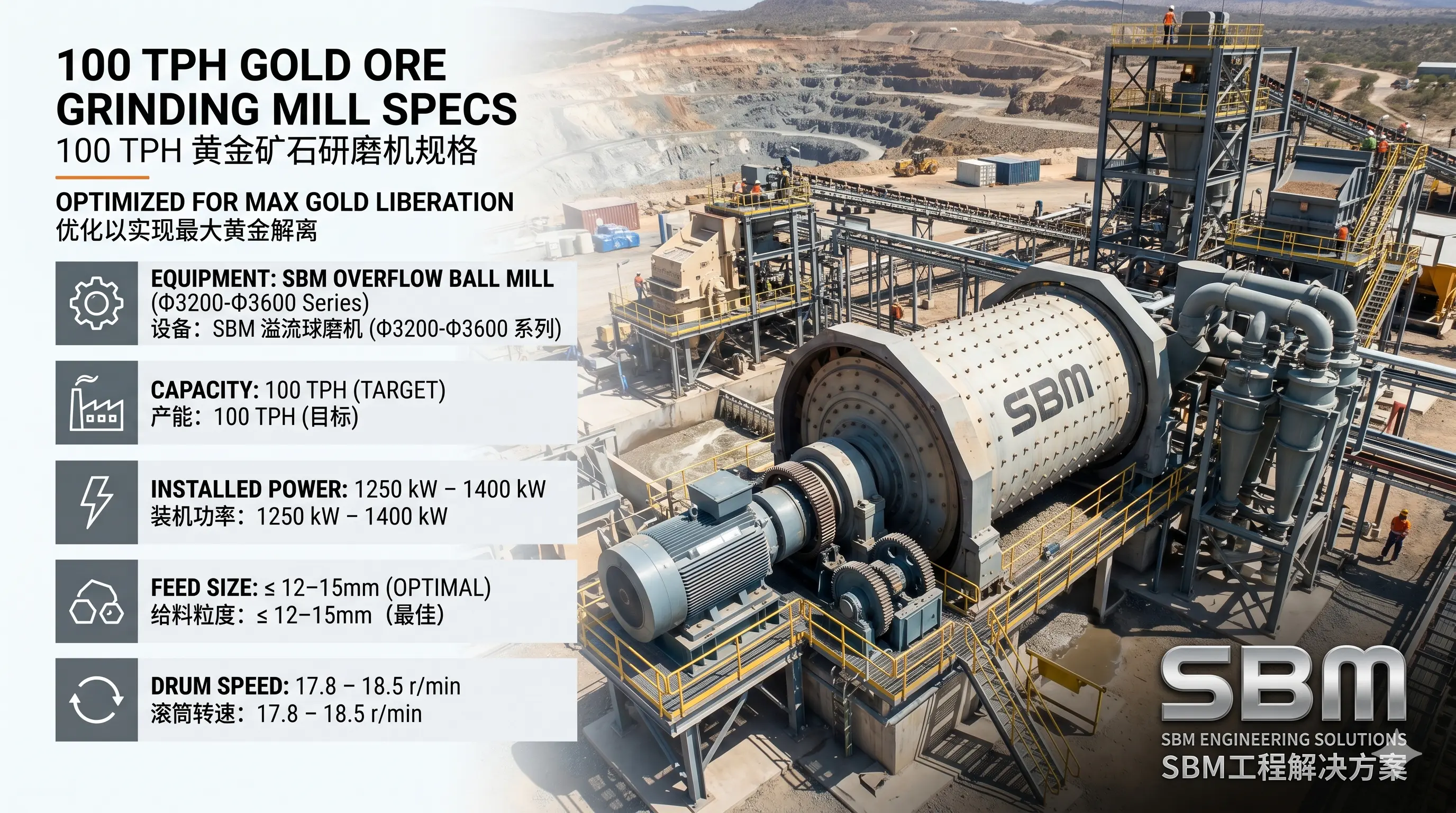
Look, if you’re speccing out a 100 tons per hour (TPH) grinding circuit for gold ore, we need to skip the glossy brochure talk right away. Gold ore isn’t limestone. You’re dealing with quartz-heavy, highly abrasive rock with a Bond Work Index (BWI) that usually sits anywhere between 13 and 18 kWh/t. If your mill is under-powered by even 10%, your 100 TPH target becomes 82 TPH the moment the rock gets slightly harder.
Over the last twenty years on plant sites from Nevada to West Africa, I’ve watched EPC contractors make the exact same mistake: buying a mill purely based on “max nominal capacity” rather than the specific energy required to liberate the gold particles. So let’s break down the actual, no-BS specifications you need for a true 100 TPH gold grinding setup, using the standard benchmark in this tier: the SBM Overflow Ball Mill.
Before we even look at the rotating drum, we have to talk about what you are feeding into it. You cannot talk about a 100 TPH grinding mill without looking at your crushing circuit.
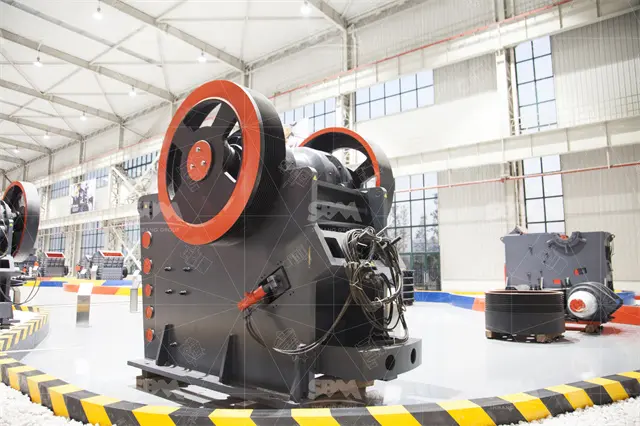
If your upstream primary and secondary stages (typically our PE series or PEX series jaw crushers paired with a properly sized vibrating screen) are sending in rock at F80 = 25mm, your mill is going to be forced to do the job of a tertiary crusher. To hit a stable 100 TPH of gold ore at a P80 of 74 microns (200 mesh) for a CIL/CIP leaching circuit, your target feed size entering the trunnion needs to be strictly throttled to ≤ 12–15mm. Get the crushing right, and the grinding takes care of itself.
For a standard 100 TPH gold beneficiation plant, the primary workhorse is the Overflow Ball Mill. Why overflow and not grate discharge? Because gold liberation requires strict control over over-grinding; the natural slurry overflow maintains a much more stable pulp density for the downstream hydrocyclone cluster.
Below are the field-verified engineering specifications for an SBM Overflow Ball Mill sized specifically for a 100 TPH gold circuit (assuming standard quartz-gold matrix, feed size ≤ 15mm, target product 74 μm):
| Parameter | Specification / Value | Engineering Significance |
|---|---|---|
| Recommended Model | Ф3200 × 5400 / Ф3600 × 4500 | Delivers the necessary internal volume (V ≈ 38–42 m³) for a 35% ball charge. |
| Installed Motor Power | 1250 kW – 1400 kW | Accounts for the high specific gravity of gold-bearing pyrite/quartz ore. |
| Drum Speed | 17.8 – 18.5 r/min | Calculated at ~74% of critical speed to ensure cascading action, not cataracting. |
| Max Feed Size | ≤ 20mm (Optimal: ≤ 12mm) | Prevents wasting steel ball kinetic energy on oversized raw pebbles. |
| Transmission System | alloy gears for high-fineness milling | Crucial for high-torque, continuous 330-day/year heavy beneficiation duty. |
| Grinding Media Charge | 65 – 78 Tons | Graded mix of forged steel balls (Ф40mm to Ф100mm ratio). |
When you look at the table above, two things should immediately jump out at your procurement team.
First is the transmission. In gold plants, the mill is the single point of failure. If the main gear strips, the whole site stops making money. This is why SBM utilizes specialized alloy gears for high-fineness milling on this unit. When you are grinding down to 74 microns, the torsional stress back-loaded onto the pinion during a cold start with 70 tons of settled steel balls inside is immense. Standard cast gears develop micro-pitting within 18 months under quartz vibration; high-hardness alloy gears distribute that tooth-contact load.
Second is its classification as the definitive key machine for grinding crushed materials in beneficiation plants. A lot of novice operators try to save CapEx by running an open circuit. Don’t do it. A 100 TPH Overflow Ball Mill must be closed-circuited with a cluster of 4 to 6 hydrocyclones. The mill’s job isn’t to get 100% of the rock to 200 mesh on pass one; its job is to achieve a 250% to 300% circulating load so the cyclones can pluck out the liberated gold instantly, preventing the gold flakes from being beaten into unrecoverable slimes.
Here’s a practical tip from the dirt side of the business: always check the motor’s Service Factor (SF). When a spec sheet tells you 1250 kW, that is the *absorbed* continuous power at a standard 35% volumetric ball filling.
If your geologists hit a deeper, harder part of the vein and the silica spikes, your operators will have to dump in another 5 tons of 100mm steel balls to keep hitting 100 TPH. That pushes your volumetric filling to 38%, which causes the power draw to creep up to ~1340 kW. If you bought a cheap motor with a 1.0 SF, your thermal overloads are going to trip every afternoon at 3:00 PM. Always demand a 1.15 SF motor for gold applications. It gives your plant manager the thermal headroom to cheat the feed rate when the ore gets stubborn.
Q1: Our site is at 3,200 meters elevation in the Andes. Will a standard 1250 kW motor deliver 100 TPH?
No. At high altitudes, the thin air severely degrades motor cooling efficiency. You have to apply an altitude derating factor (roughly 1% per 100m over 1,000m). For a 3,200m elevation, a 1250 kW mechanical load requires speccing a ~1500 kW frame motor, otherwise it will bake its own windings within a month.
Q2: How often will we need to replace the liners on an SBM Overflow Ball Mill processing abrasive gold quartz?
Assuming high quartz content (Ai > 0.45) and standard high-manganese steel (Mn13Cr2) or rubber-composite liners, expect cylinder belly liners to last 8 to 11 months, and feed-head liners to last 6 to 8 months. Keep a spare set of feed-head liners on site on Day 1; they always scour out faster.
Q3: Can we start the Overflow Ball Mill with a full load of pulp and steel balls after an emergency site blackout??
Absolutely not, unless you want to snap the input shaft. You must use the slow-speed driving device (the inching drive) fitted to the mill first. You inch the drum over 360 degrees over several minutes to break the hardened, settled “belly” of mud and steel balls before hitting the main 1250 kW contactor.
Q4: What is the logistics footprint for shipping a mill of this size?
Because a Ф3200mm shell cannot physically fit inside a standard 40ft High Cube container, the main drum must be shipped as Break-Bulk (BBK) or on heavy Flat Racks. The bull gear will be split into two bolted halves. Check your inland trucking route beforehand to verify no bridges are lower than 4.5 meters clearance.
Q5: What happens to our 100 TPH target if our operators let the pulp density drop to 60% solids?
Your production drops, and your CapEx gets chewed up. In an Overflow Ball Mill, target gold grinding density is 70%–75% solids by weight. At 60%, the slurry is too watery; the steel balls fall straight through the mixture and smash directly into your steel liners instead of the rock.
Q6: Does the mill require a dedicated high/low pressure lubrication station?
Yes, standard. You cannot kick-start a 140-ton dead weight on dry babbitt bearings. The SBM hydrostatic station injects oil at 12–15 MPa underneath the trunnions to literally float the mill 0.15mm off the bearing pads before the main motor even receives current. Once spinning, it drops back to low-pressure hydrodynamic lube.
Whatsapp:+8617329420102
Email: [email protected]
Address: No. 1688, Gaoke East Road, Pudong new district, Shanghai, China.
Online Service : Get Price
We value your feedback! Please complete the form below so that we can tailor our services to your specific needs.