A 250 TPH basalt crushing line in Indonesia typically centers on a mid-range cone crusher handling secondary or tertiary reduction. Basalt in Indonesia commonly presents at 200–280 MPa compressive strength with abrasion index values between 0.3 and 0.6, which directly affects liner wear rates and cost projections. This guide covers equipment selection logic, real operating costs, and maintenance practices specific to Indonesian basalt crushing conditions.
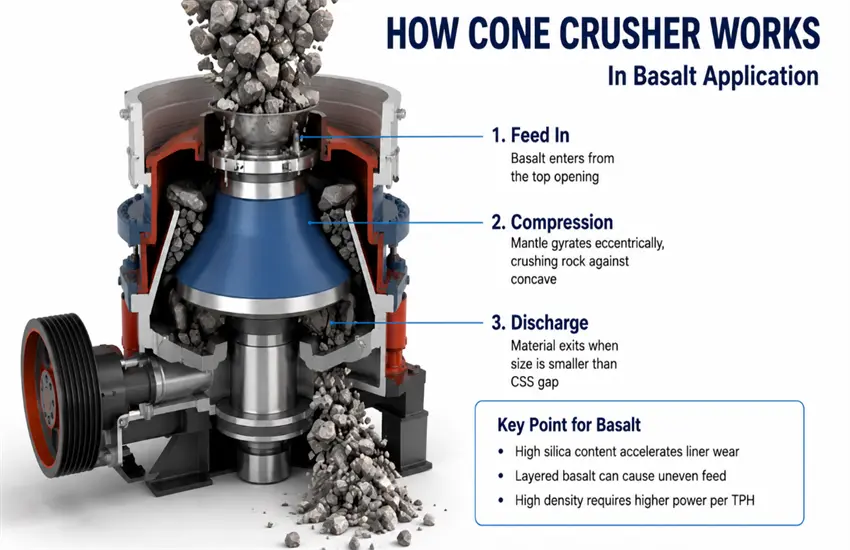
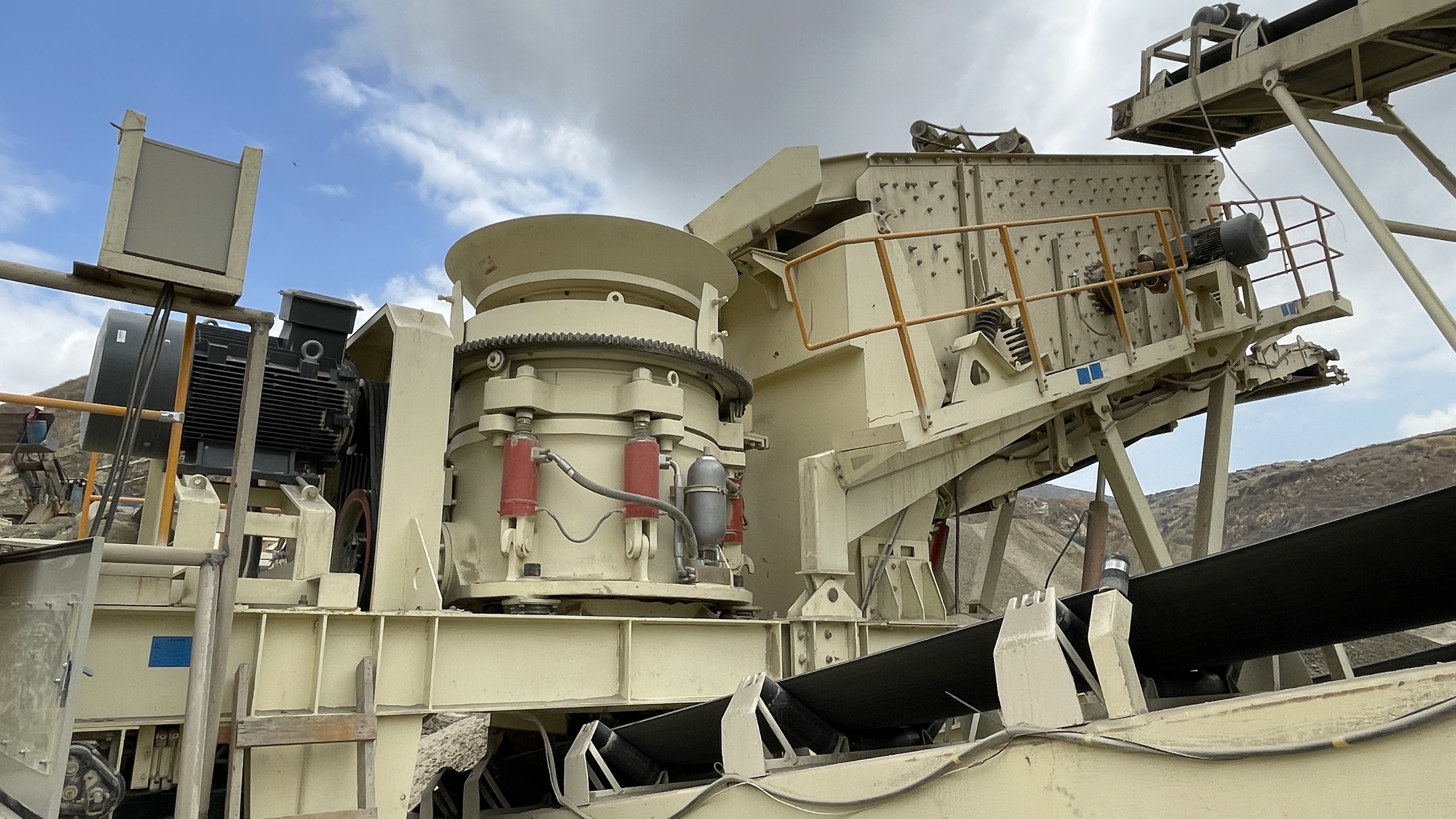
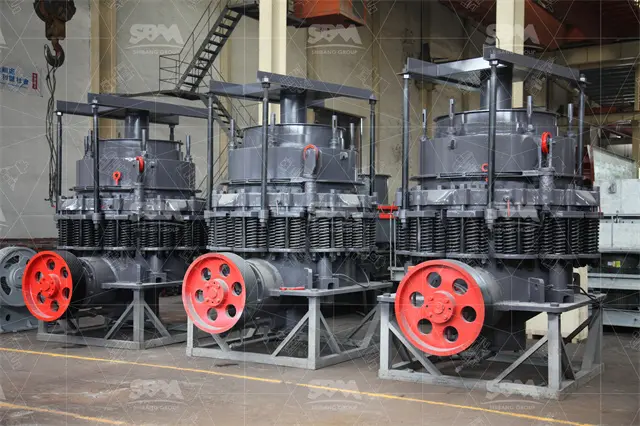
A cone crusher reduces rock by squeezing material between a rotating mantle and a stationary concave bowl. The mantle gyrates eccentrically — not rotating — creating a continuous compression cycle. This is different from jaw crushers, which use linear reciprocating motion.
In basalt applications, the key mechanism is interparticle compression. As basalt enters the crushing chamber from the top, it is progressively compressed toward the closed side setting (CSS). Material exits when particle size falls below the CSS gap.
For basalt specifically:
The CSS controls output gradation. Changing CSS by 5 mm typically shifts D80 output size by 8–12 mm depending on feed gradation and chamber profile.
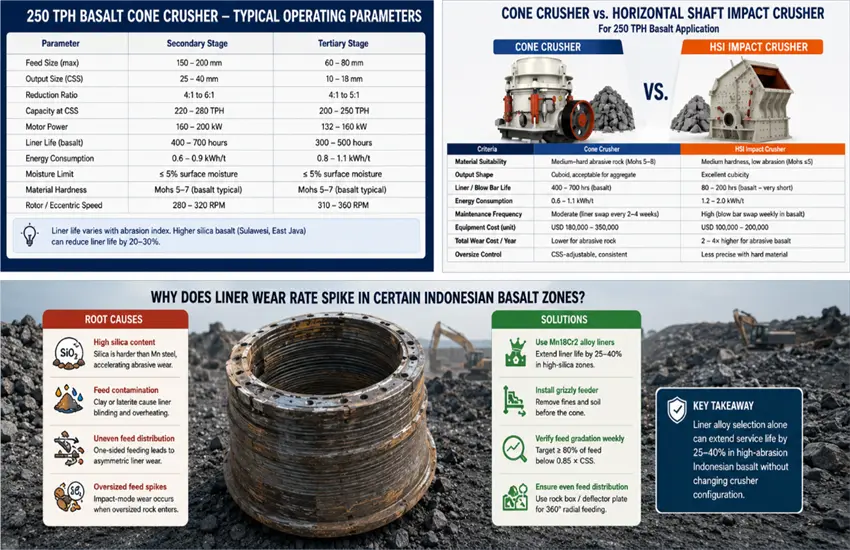
The following parameters apply to a cone crusher in secondary or tertiary position within a 250 TPH basalt line. Values reflect typical plant settings, not catalog maximums.
| Parameter | Secondary Stage | Tertiary Stage |
|---|---|---|
| Feed Size (max) | 150–200 mm | 60–80 mm |
| Output Size (CSS) | 25–40 mm | 10–18 mm |
| Reduction Ratio | 4:1 to 6:1 | 4:1 to 5:1 |
| Capacity at CSS | 220–280 TPH | 200–250 TPH |
| Motor Power | 160–200 kW | 132–160 kW |
| Liner Life (basalt) | 400–700 hours | 300–500 hours |
| Energy Consumption | 0.6–0.9 kWh/t | 0.8–1.1 kWh/t |
| Moisture Limit | ≤5% surface moisture | ≤4% surface moisture |
| Material Hardness | Mohs 5–7 (basalt typical) | Mohs 5–7 |
| Rotor/Eccentric Speed | 280–320 RPM | 310–360 RPM |
Liner life estimates assume Indonesian basalt with abrasion index 0.35–0.55. Higher silica zones (Sulawesi, East Java) can reduce liner life by 20–30% compared to lower-abrasion basalt from West Java regions.
Both crusher types can handle basalt, but the trade-offs in cost, wear, and output shape are significant. The right choice depends on final product spec and abrasion tolerance.
| Criteria | Cone Crusher | HSI Impact Crusher |
|---|---|---|
| Material Suitability | Medium–hard abrasive rock (Mohs 5–8) | Medium hardness, low abrasion (Mohs ≤5) |
| Output Shape | Cuboid, acceptable for aggregate | Excellent cubicity |
| Liner/Blow Bar Life | 400–700 hrs (basalt) | 80–200 hrs (basalt — very short) |
| Energy Consumption | 0.6–1.1 kWh/t | 1.2–2.0 kWh/t |
| Maintenance Frequency | Moderate (liner swap every 2–4 weeks) | High (blow bar swap weekly in basalt) |
| Equipment Cost (unit) | USD 180,000–350,000 | USD 100,000–200,000 |
| Total Wear Cost/Year | Lower for abrasive rock | 2–4× higher for abrasive basalt |
| Oversize Control | CSS-adjustable, consistent | Less precise with hard material |
For Indonesian basalt above 150 MPa, cone crushers are the standard choice. Impact crushers may work in low-abrasion volcanic tuff, but in dense crystalline basalt, blow bar consumption becomes the dominant operating cost. Many Indonesian operators learn this after one season with impact crushers on hard basalt.
This is one of the most common technical complaints in Indonesian basalt operations. Liner life drops well below 400 hours in some sites, which breaks the cost model.
Liner alloy selection alone can extend service life by 25–40% in high-abrasion Indonesian basalt without changing crusher configuration.
Operators in tropical climates like Indonesia often report that actual throughput fluctuates between 180–250 TPH even when crusher settings are unchanged. This is a process problem, not usually an equipment failure.
Cost estimation for a basalt cone crusher in Indonesia needs to separate capital cost (CAPEX) from ongoing operating cost (OPEX). The two are often confused in budget discussions.
| Cost Item | Estimate (USD/month) | Notes |
|---|---|---|
| Electricity (0.8 kWh/t avg) | 4,000–6,500 | Based on PLN industrial tariff ~USD 0.10–0.13/kWh |
| Mantle + Concave replacement | 2,500–5,000 | Depends on basalt abrasion level |
| Lubrication oil | 300–600 | Oil change every 500–800 hours |
| Routine maintenance labor | 800–1,500 | Local technician rates |
| Unplanned downtime allowance | 500–1,200 | Tramp iron damage, liner failure |
Wear parts are the largest variable in Indonesian basalt operations. A site with high-abrasion basalt (abrasion index >0.5) can see liner costs 2× higher than a site with moderate-abrasion basalt. This difference alone can shift cost per tonne by USD 0.30–0.60/t.
During the first wet season, screen panels in the tertiary circuit blinded within 4–6 hours of operation due to high-moisture basalt fines. Recirculating load spiked to 40% of fresh feed, dropping effective output to 190 TPH.
Replaced woven wire panels with polyurethane self-cleaning panels on the bottom deck of the tertiary screen. Added a forced-air blower system over the middle deck. This brought recirculating load back to 18–22% and restored output to 225+ TPH during wet season.
Feed inspection showed 8–12% clay contamination mixed with crushed basalt from the quarry face. Clay coating the liner reduced effective compression and increased heat buildup. Feed moisture reached 7–9% during rainy months.
| Task | Interval | Typical Duration |
|---|---|---|
| Liner wear measurement | Every 100 hours | 1 hour |
| Liner replacement (mantle) | 400–600 hours (basalt) | 8–12 hours |
| Liner replacement (concave) | 400–550 hours (basalt) | 6–10 hours |
| Oil analysis and change | 500–800 hours | 2–3 hours |
| Eccentric bushing inspection | 2,000 hours | 4–6 hours |
| Main shaft and frame inspection | Annual | 1–2 days |
Indonesian quarry operations frequently encounter rebar and drill bits from blasting. Install a magnetic separator or tramp iron release system. A cone crusher without tramp release that encounters steel will stall, and in worst cases crack the main frame — repair cost exceeds USD 30,000–80,000.
For 250 TPH basalt in secondary position, a cone crusher with 160–200 kW motor and nominal chamber diameter of 1,000–1,200 mm is typical. At CSS 30–35 mm with basalt, this range produces 220–280 TPH depending on feed gradation. Avoid selecting a crusher at rated maximum capacity — basalt density and abrasion index require 10–15% headroom. If basalt compressive strength exceeds 250 MPa, size up to the next model. Running at 90%+ of rated capacity on hard abrasive rock shortens bearing life and increases liner wear rate.
In Indonesian basalt with typical abrasion index 0.35–0.55, expect 400–600 hours for mantles and concaves with standard Mn18 alloy. Key factors that shorten liner life: silica content above 50%, clay contamination in feed, feed moisture above 5%, and operating at CSS below 15 mm (tertiary). Liner life below 300 hours usually indicates a feed quality problem rather than alloy failure — check for tramp iron damage, abnormal feed gradation, or clay coating on liners. Upgrading to Mn18Cr2 or chrome-moly alloy liners is cost-effective when basalt abrasion index exceeds 0.5.
Total crushing cost per tonne for a 250 TPH basalt cone crusher in Indonesia typically falls in the range of USD 1.20–2.80/t for the crusher stage alone, excluding quarrying and primary crushing. Breakdown: electricity 0.40–0.70/t, liner wear 0.50–1.20/t, maintenance labor 0.15–0.30/t, other parts 0.15–0.60/t. Sites with high-abrasion basalt and short liner life cluster toward the upper range. Sites with clean feed, moderate abrasion, and consistent operation achieve the lower range. These figures are based on typical Indonesian PLN electricity tariffs and local maintenance labor rates as of current market conditions.
The cost and performance of a 250 TPH basalt cone crusher in Indonesia depend heavily on basalt hardness, silica content, feed moisture management, and liner alloy selection. These are not just procurement decisions — they require site-specific engineering input before finalizing equipment specification.
The main variables to nail down before selecting equipment:
We supply cone crushers, complete 250 TPH basalt crushing lines, and wear parts stocked in Indonesia. We also provide on-site commissioning support and technical after-sales for liner selection and circuit optimization. If you have basalt rock samples or quarry data, share them and we can give you a grounded equipment recommendation with realistic operating cost estimates for your specific site.
Whatsapp:+8617329420102
Email: [email protected]
Address: No. 1688, Gaoke East Road, Pudong new district, Shanghai, China.
Online Service : Get Price
We value your feedback! Please complete the form below so that we can tailor our services to your specific needs.