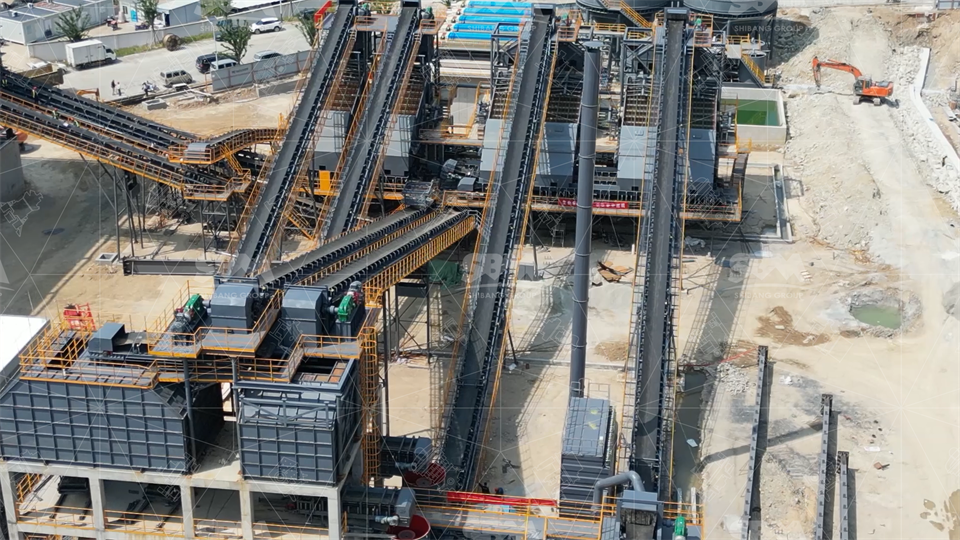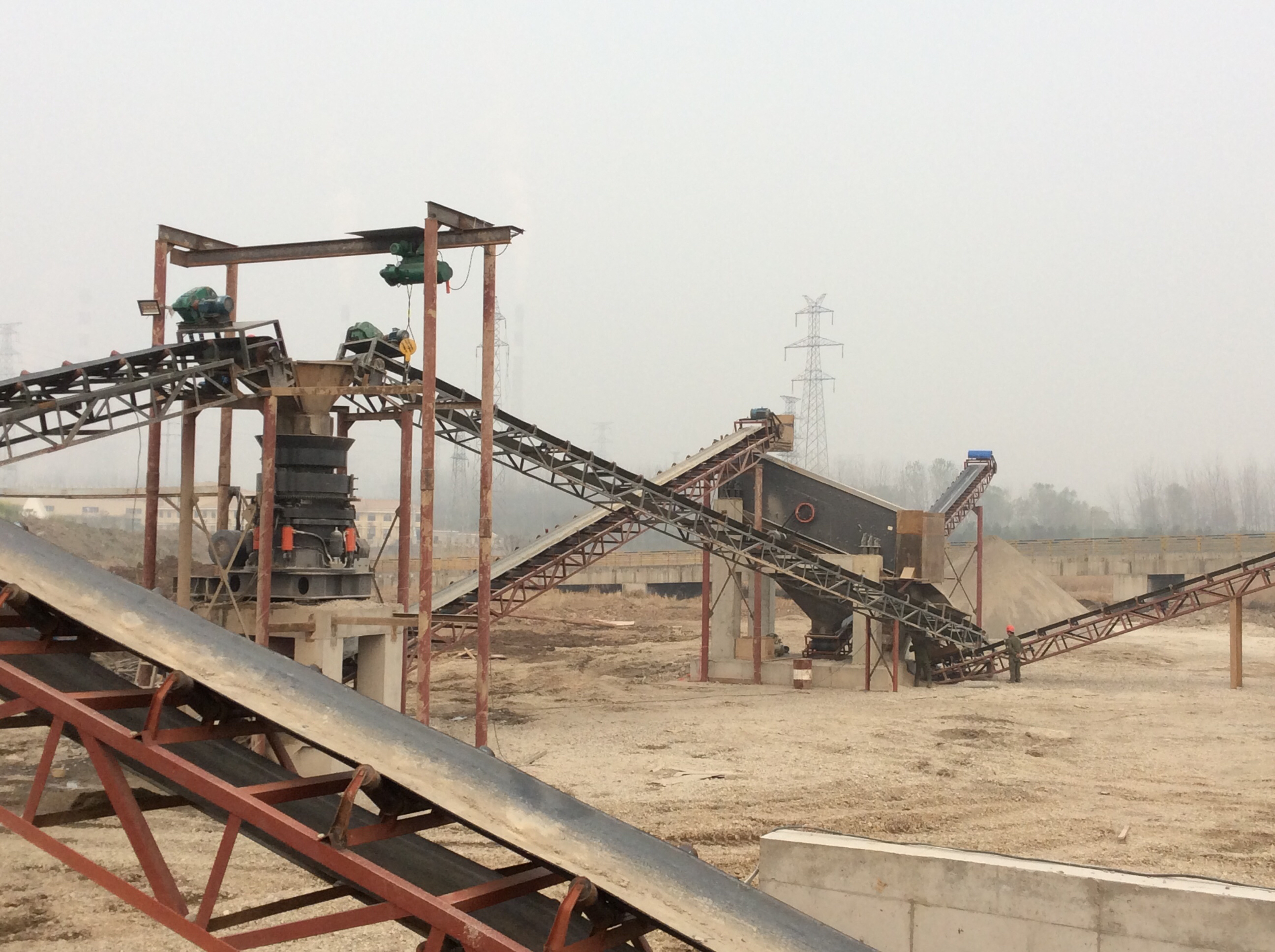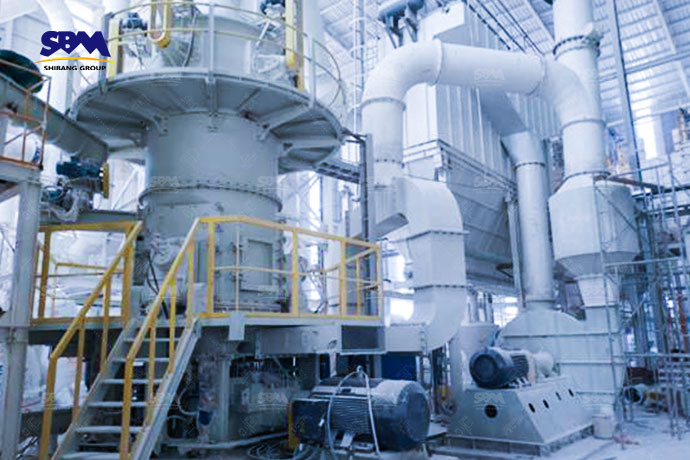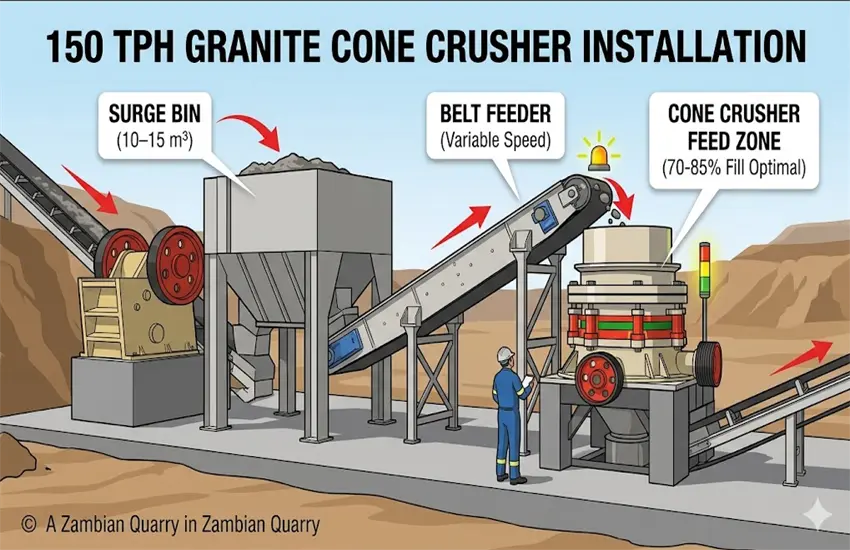
A 150 TPH granite crushing line in Zambia typically centers on a cone crusher as the secondary or tertiary stage, handling feed from a jaw crusher and producing aggregates in the 5–20 mm range. Granite in Zambia’s Copperbelt and Southern Province often shows compressive strength between 160–220 MPa, which places specific demands on liner selection and motor sizing. This article covers equipment selection logic, real operating parameters, common field issues, and cost considerations for this configuration.
A cone crusher breaks rock by compressing material between a rotating mantle and a stationary concave bowl. The mantle gyrates eccentrically — it does not spin. This creates a progressive squeezing action as material moves downward through the crushing chamber.
In a 150 TPH granite line, the cone crusher typically handles material already reduced by a jaw crusher to 80–150 mm. The cone then reduces this to 20–40 mm (secondary) or 5–20 mm (tertiary), depending on CSS setting. Material exits through the bottom opening by gravity. Fines content increases as CSS narrows, which also raises power draw and liner wear rate.
The key mechanical components are:
The parameters below reflect typical operating ranges for a cone crusher at 150 TPH on granite. Actual values shift depending on feed gradation, moisture, and fines content.
| Parameter | Typical Range | Notes |
|---|---|---|
| Feed Size (max) | ≤ 150 mm | After jaw crusher pre-crush |
| Output Size | 5–40 mm | Depends on CSS and chamber type |
| CSS Range | 8–25 mm | Fine/medium/coarse chamber options |
| Reduction Ratio | 4:1 – 8:1 | Typical for cone crushers on hard rock |
| Throughput Capacity | 130–165 TPH | Varies with feed PSD and moisture |
| Motor Power | 160–220 kW | Granite requires higher end |
| Liner Life | 400–800 operating hours | High-Mn steel on granite; abrasion index dependent |
| Energy Consumption | 0.9–1.4 kWh/t | Higher with finer CSS settings |
| Max Moisture | ≤ 8% | Above this, clay content causes packing |
| Material Hardness | Mohs 5.5–7 | Granite typically Mohs 6–7 |
| Rotor/Eccentric Speed | 250–350 RPM | Model-dependent |
At CSS 10–12 mm, expect output around 50–60% in the 5–10 mm fraction. At CSS 16–20 mm, the 10–20 mm fraction dominates. Fines below 3 mm increase proportionally as CSS narrows — this matters for aggregate specifications in Zambian road construction contracts.
This is a common selection question. Both are secondary/tertiary options, but they behave very differently on hard granite.
| Factor | Cone Crusher | Impact Crusher (HSI/VSI) |
|---|---|---|
| Feed Hardness | Suitable for Mohs 5–8 | HSI suited to Mohs ≤ 5; VSI handles harder |
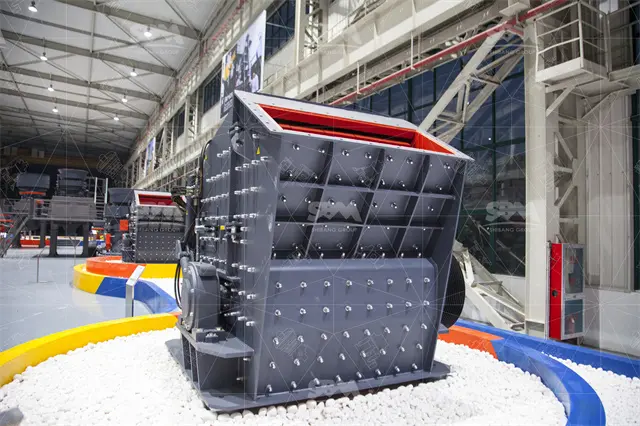
| Granite (Mohs 6–7) | Good fit — compression suits hard rock | HSI: high wear rate, not recommended |
| Output Shape | Cuboid, slight flakiness at wide CSS | VSI: excellent cubicity |
| Liner/Blow Bar Life | 400–800 h on granite | HSI blow bars: 150–250 h on granite |
| Energy per Ton | 0.9–1.4 kWh/t | HSI: 1.5–2.5 kWh/t on granite |
| Maintenance Frequency | Liners every 400–800 h | Blow bars every 150–300 h (HSI on granite) |
| Capex | Higher initial cost | Lower initial cost |
| Long-term Operating Cost | Lower on hard rock | Higher wear consumables on hard rock |
| Dust Generation | Moderate | Higher fines, more dust |
| Clay/Moisture Sensitivity | Moderate (packing risk > 8%) | Low tolerance for clay or wet feed |
For Zambia granite at 150 TPH, a cone crusher is the practical choice for secondary crushing. If cubic shape for asphalt aggregate is the end goal, a VSI can follow as a tertiary stage. Using an HSI on granite significantly increases operating cost due to rapid blow bar wear — liner cost per ton can triple compared to a cone.
Stalling and overload are the two most common operational problems in 150 TPH granite lines. Understanding the cause matters before adjusting settings.
If the jaw crusher discharges in surges — common when the feeder speed is not matched — the cone receives irregular feed volume. A full chamber runs hot and draws peak amps. An empty chamber wastes capacity and accelerates liner wear by point-loading.
Solution: Install a surge bin (10–15 m³) between jaw and cone with a belt feeder on variable speed control. This levels the feed rate and keeps cone chamber fill at 70–85% — the optimal operating zone.
Operators sometimes reduce CSS to meet product spec without checking whether the incoming feed PSD matches the chamber design. If 30–40% of feed is near the closed-side setting, the crusher overloads quickly.
Recommended check: Measure the P80 of jaw crusher output. CSS should be at most 25–30% of the P80 feed size for stable operation. For a jaw producing P80 at 100 mm, cone CSS should not go below 25–30 mm without a mid-stage screen.
Zambian quarry granite occasionally contains quartz veins or surface laterite with embedded hard inclusions. Hydraulic cone crushers handle this via the tramp release system — the bowl lifts momentarily. However, if the hydraulic accumulator pressure is low or relief valve is worn, the cone stalls instead of releasing.
Maintenance check: Inspect accumulator pre-charge pressure every 500 operating hours. Typical pre-charge for a 160–220 kW cone is 8–12 MPa nitrogen pressure in the accumulator.
Granite’s silica content (typically 60–70% SiO₂) drives abrasive liner wear. But premature wear — faster than the 400–800 h baseline — usually has a controllable cause.
When the chamber fill ratio drops below 50%, the crushing action becomes impact-dominant rather than compression-dominant. Impact loading accelerates liner cracking and spalling. This is especially common during shift changes when operators reduce feed rate unnecessarily.
Target: Maintain minimum 60% chamber fill at all times. Visual inspection of the feed hopper level and amperage monitoring help track this.
Standard 14% Mn liners work on many applications. For high-silica granite at Mohs 6.5–7, a higher Mn content (18–22% Mn) or Mn-Cr alloy liner reduces wear rate by 20–35% in typical plant settings. The trade-off is higher liner cost per set, but lower wear rate extends intervals enough to reduce total annual liner spend.
Do not wait until a liner is fully spent. Replace at 80% wear level. At beyond 80% wear, the crushing chamber geometry changes, output gradation shifts coarser, and recirculating load on the screen increases — adding wear to conveyor belts and screen media as a secondary cost.
During the first rainy season, feed moisture reached 6.5–7%. Clay from surface quarry layers mixed with granite fines. The cone chamber began packing — discharge belt showed sluggish flow and motor amps climbed 15% above normal. Resolution: The quarry added a scalping screen before the jaw crusher to remove minus 30 mm fines and clay-rich material. Feed moisture entering the cone dropped back to 4–5%. Packing incidents stopped within two weeks of modification.
| Cost Item | Typical Range | Basis |
|---|---|---|
| Energy (cone + ancillary) | USD 0.09–0.14/t | At 0.08–0.10 USD/kWh grid rate |
| Liner consumables | USD 0.12–0.20/t | 18–22% Mn liners, 500 h interval |
| Lubrication (oil + grease) | USD 0.01–0.02/t | Scheduled change every 1,000 h |
| Maintenance labor | USD 0.05–0.08/t | Local technician rates, Zambia |
| Unplanned downtime allowance | 5–8% production loss | Tramp events, liner change delays |
A complete 150 TPH granite line — feeder, jaw, cone, screens, conveyors, electrical — typically represents a mid-range capital commitment. Line price varies with automation level, civil foundation requirements, and whether a VSI tertiary stage is included. Zambia’s import duties on mechanical equipment and local erection costs should be factored into total installed cost calculations.
Lines without intermediate surge bins often show 10–15% lower actual throughput than nameplate due to feed irregularity. Adding a surge bin adds capital cost but typically pays back in 6–12 months through improved liner life and reduced overload events.
| Interval | Task |
|---|---|
| Daily (8 h) | Check oil level, oil temperature, feed level, discharge clearance, motor amps |
| Weekly (50 h) | Inspect dust seal, check hydraulic pressure, grease spider bearing |
| 250 h | Eccentric clearance check, bowl float check, oil sample analysis |
| 500 h | Inspect liners for wear profile, measure CSS at multiple points, check drive V-belts |
| 1,000 h | Full oil change, inspect eccentric bushing, check main frame for cracks |
Total line price depends heavily on configuration. A basic line with jaw crusher, cone crusher, one double-deck screen, feeders, and conveyors starts at a different cost level than a line with VSI tertiary, three-deck screens, automated controls, and dust suppression. As a general reference, complete 150 TPH hard rock lines in the African market range widely based on equipment specification, country of manufacture, and port-to-site logistics. Requesting a detailed bill of quantities with defined product specs (e.g., 0–5 / 5–10 / 10–20 mm split, all-in aggregate, or specific gradation) allows accurate pricing. Vague inquiries typically result in under-specified quotes that miss hidden costs like surge bins, electrical panels, and commissioning.
With granite at Mohs 6.5 and SiO₂ content around 60–65%, standard 14% Mn liners wear at 600–900 g/t crushed in typical operating conditions. At a throughput of 150 TPH, this means a liner set may last 400–600 hours before the chamber profile degrades enough to shift product gradation. Using 18–22% Mn or Mn-Cr liners extends life to 500–800 hours in similar conditions. Monitor liner wear by measuring CSS at three clock positions (12, 4, and 8 o’clock) every 250 hours. When any single measurement deviates more than 3–4 mm from the others, the liner wear is uneven — check feed distribution and consider rotation or replacement.
Cone crushers tolerate moisture up to about 6–8% without significant operational impact, assuming the material is clean granite without clay fines. In Zambia’s rainy season (November–March), surface quarry material often carries clay-contaminated fines at the minus 30 mm fraction. This clay-fines fraction is the real problem — not the moisture itself. It packs the crushing chamber and reduces throughput by 15–25%. The practical solution is to add a scalping screen or grizzly before the jaw crusher to reject the minus 30–50 mm fraction during wet periods. Stockpiling and allowing material to drain for 24 hours before crushing also reduces chamber packing incidents significantly.
A 150 TPH granite cone crusher line in Zambia is a technically specific configuration. Feed hardness, product gradation targets, moisture management, and liner selection all affect whether the line performs at nameplate capacity or runs at 70–80% due to avoidable operational issues.
The equipment choices that matter most are:
We supply complete granite crushing lines with equipment selection based on your material test data, feed gradation, and product requirements. Technical support covers installation, commissioning, liner selection, and spare parts supply. If you have quarry material data — compressive strength, feed size, target output gradation — share it for a line configuration and price proposal specific to your Zambia project.
Whatsapp:+8617329420102
Email: [email protected]
Address: No. 1688, Gaoke East Road, Pudong new district, Shanghai, China.
Online Service : Get Price
We value your feedback! Please complete the form below so that we can tailor our services to your specific needs.